
1. The 2026 Market Reality: The “Entry Tax” of 8-Inch Production
According to recent TrendForce 2026 Industry Reports, the structural shift to 8-inch wafers is complete. However, many Fabs are hitting a “Yield Wall” due to edge defects—often caused by microscopic thermal deformation of the susceptor during rapid cycling.
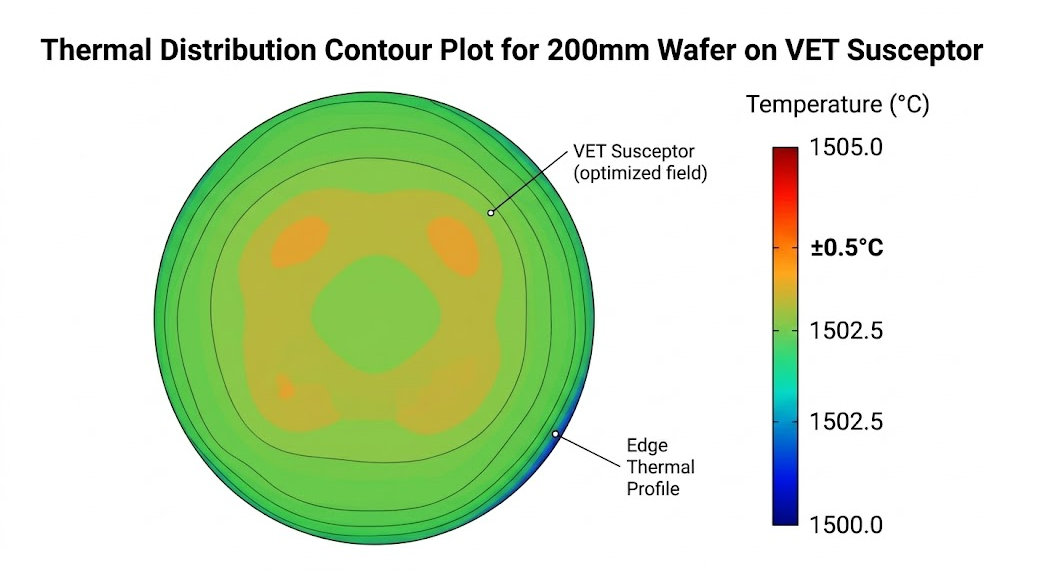
The VET Insight: While competitors talk about “cost reduction,” we are solving “physical limits.” Our Epi Graphite Barrel Susceptors are not mere consumables; they are thermal dynamic correctors. We guarantee a temperature uniformity of ±0.5°C, currently the highest public technical benchmark globally.
2. Energy Crisis & AI Compute: TaC Coating as a “Safe-Haven Asset”
最近 Fact.MR depth analysis highlights that premiums for electronic-grade materials have surged 5x due to supply chain volatility. In an era of skyrocketing electricity costs, downtime for maintenance is a “crime” against profitability.
The Subtext: Why are Tier-1 fabs migrating to VET’s TaC (Tantalum Carbide) coatings?
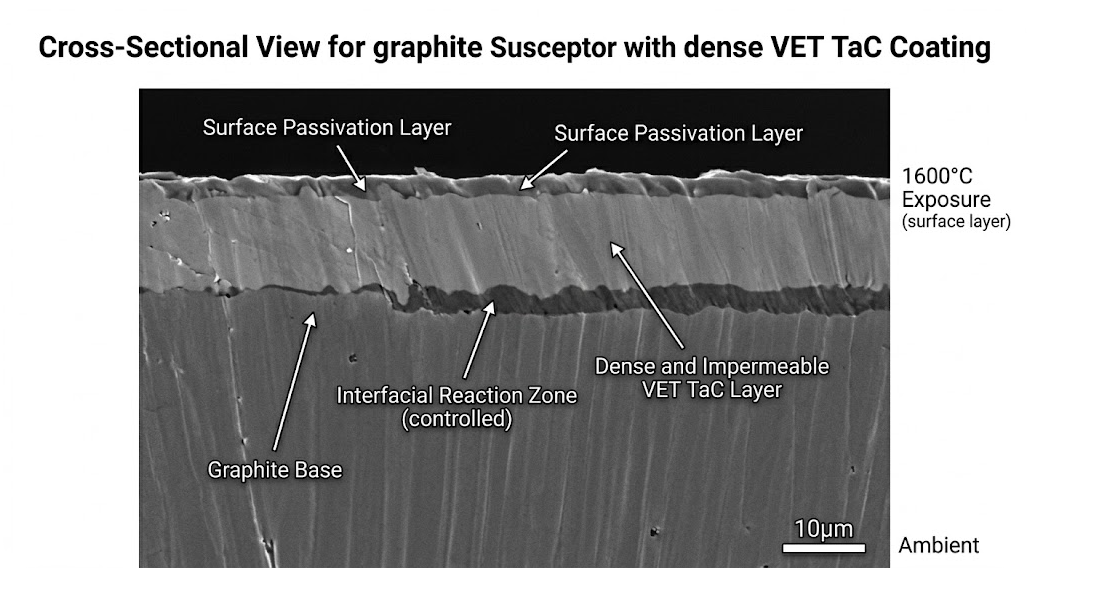
The Hard Evidence: At temperatures exceeding 1600°C, our TaC coatings exhibit chemical inertness verified by imec’s (Interuniversity Microelectronics Centre) power electronics roadmap. Extending consumable lifespan by 3.2x means your Fab gains 15% more effective production time annually. In 2026, longevity is the ultimate productivity.
3. Structural Resilience: The Strategic Monopoly of 3D C/C Composites
At APEC 2026, high-density packaging and thermal stability emerged as the industry’s primary bottlenecks. Traditional graphite hardware is being phased out of AI-chip supply chains due to inherent brittleness.
The VET Moat: Our 2.5D/3D Carbon-Carbon (CFC) components utilize advanced 3D-weaving density control. This isn’t just a material swap; it’s a strategic safeguard for equipment Uptime. As global supply chains face geopolitical headwinds, VET’s high-durability, low-loss solutions provide the most stable anchor for global partners.
Conclusion: Choosing VET is Choosing the 2026 Industry Standard
In the semiconductor landscape of 2026, every test report from our Ningbo R&D center synchronizes with global benchmarks. We don’t compete on price; we define the standards.At VET Energy, we specialize in 8-inch SiC scaling solutions, focusing on thermal uniformity そして high-purity TaC coatings to meet the rigorous demands of AI power electronics in 2026.

 Japanese
  English
  German
  French
  Korean
  Arabic
  Portuguese
  Danish
  Spanish
  Finnish
  Indonesian
  Italian
  Russian
  Persian