
Maximizing ROI: The Financial Logic of Switching to TaC Coatings
In the competitive semiconductor landscape, the “initial purchase price” is often a misleading metric. For manufacturers scaling up to 8-inch SiC/GaN production, true profitability is found in Total Cost of Ownership (TCO).
At Vetek Semiconductor, we advocate for Tantalum Carbide (TaC) not just as a technical upgrade, but as a strategic financial decision to lower your Cost per Wafer.
Beyond Silicon: Why TaC Coating is Becoming the Gold Standard for 2000°C+ Environments
In the rapidly evolving power electronics landscape of 2026, we are pushing wide-bandgap semiconductors to their physical limits. As the demand for higher growth rates and superior crystalline quality intensifies, the industry is moving toward higher processing temperatures—often exceeding 2000°C. At these extremes, traditional materials fail, and Tantalum Carbide (TaC) coating emerges as the critical enabler.
Scaling Excellence: Solving Thermal Field Challenges in the 8-Inch SiC Era
In 2026, the semiconductor industry is no longer just a race for smaller nanometers; it is a race for material stability at extreme limits. As global production scales toward 8-inch Silicon Carbide (SiC) wafers to meet the demands of AI and high-voltage power electronics, the industry faces a critical bottleneck: Thermal Field Uniformity.
Navigating the 200mm Transition: Why TaC Coating is the Deciding Factor for 8-inch SiC Yields
Introduction As the global power electronics industry aggressively shifts from 150mm (6-inch) to 200mm (8-inch) SiC wafer production, the conversation often stays on the reactors themselves. However, at the heart of the MOCVD and Epitaxy process lies a silent but critical component: the graphite susceptor. If you are seeing a drop in yield or unexpected crystal defects as you scale to 8-inch, you aren’t alone. The thermal and chemical stresses at 1600°C+ are pushing traditional coatings to their breaking point.
The Endgame of 200mm SiC Scaling: Who Defines the Yield Ceiling in 2026?
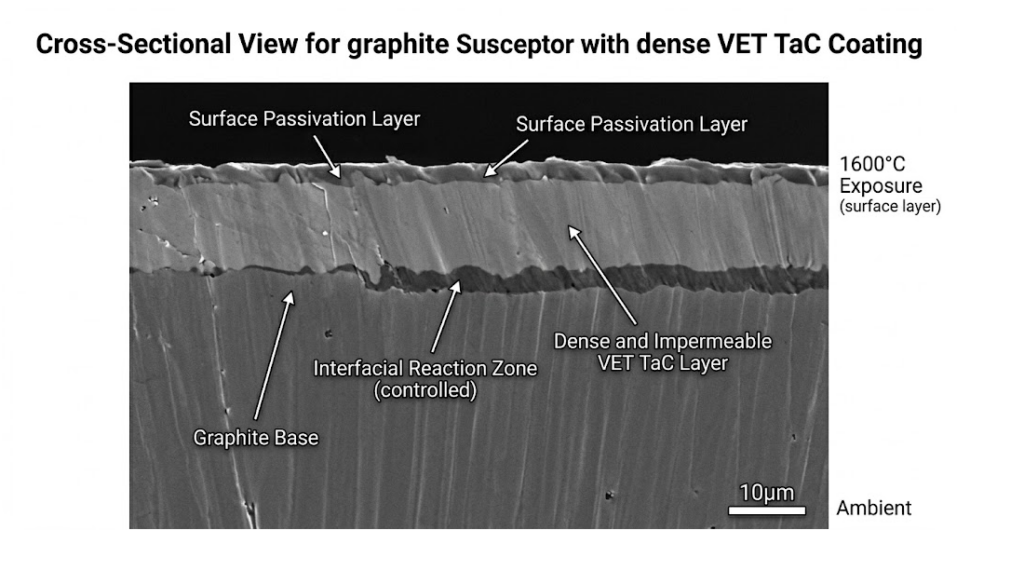
As global leaders transition to total 200mm (8-inch) SiC production, the industry focus has shifted from “capacity” to “atomic-level control.” In the high-stakes environment of 2026, the real competition isn’t about wafer count—it’s about the coating technology that dictates your Fab’s bottom line.
Scaling to 200mm SiC: Why High-Purity Coatings are the 2026 Benchmark for Power Electronics
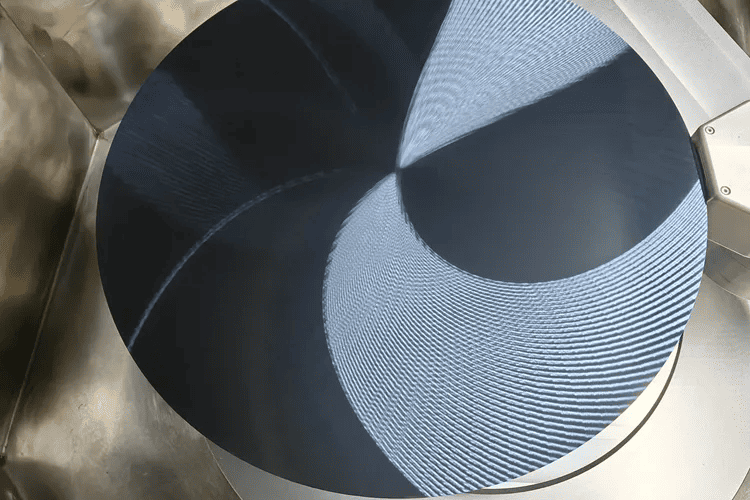
As the semiconductor industry shifts toward 200mm (8-inch) SiC wafer production, thermal management at 1600°C has become a critical bottleneck. This article explores how advanced CVD TaC coatings and 3D C/C composites—backed by research from institutions like Fraunhofer IISB and imec—are redefining durability and wafer yield in 2026.
2.5D 3D Carbon Fiber Composite C/C Brake Pad CFC Disc
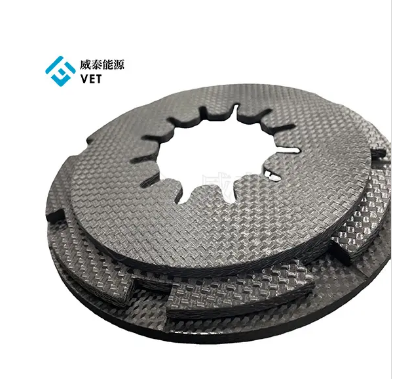
VET Energy is a professional manufacturer and supplier of customized Carbon Fiber Composites (C/C) parts. With a complete R&D and manufacturing system, we handle core processes like carbon fiber preform preparation, chemical vapor deposition, and precision machining. Our products feature high-temperature strength, excellent dimensional stability, and outstanding thermal conductivity. You’re welcome to visit our factory for more details.
Core Applications of TAC Coating in Semiconductor Manufacturing

Tantalum carbide-coated components are primarily used in semiconductor chip manufacturing for wafer processing, oxidation diffusion, epitaxy, and etching. They are also applied in graphite accessories for silicon carbide crystal growth furnaces. Domestic technology leads globally, though there is still a gap compared to foreign advancements. However, the large market share in the Asia-Pacific region offers significant growth potential for tantalum carbide coating applications.
What Makes CVD Graphite Parts Indispensable in Extreme Heat Conditions

CVD Graphite Parts offer unmatched thermal stability, conductivity, and chemical resistance, making them vital for extreme heat and high-temperature applications.
The Science of Ceramic Coatings and Their Protective Power

Ceramic coatings use nanotechnology to bond with car paint, creating a durable, hydrophobic shield that resists UV rays, chemicals, and scratches.