
Why TaC Coating is a Game-Changer for High-Temp Nitrogen Processes

The Problem with Standard Coatings

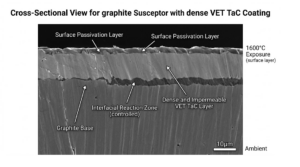
Most coatings start to break down or “peel” when temperatures exceed 1600°C. In nitrogen-rich processes, this leads to:

  • Contamination of the wafer.

  • Frequent replacement of parts.

  • Higher production costs.

The TaC Solution

TaC is a “super-ceramic” with a melting point of 3880°C. Here is why it lasts longer in your reactor:

  1. Extreme Heat Resistance: It stays solid and stable far beyond the point where SiC coatings fail.

  2. Nitrogen Shield: TaC is chemically “lazy”—it doesn’t react with nitrogen. This prevents the coating from pitting or eroding over time.

  3. Perfect Match: It expands and contracts at the same rate as graphite, meaning no cracks during fast heating and cooling.

The Result: Lower Costs, Better Yields

By switching to TaC-coated parts, our clients see:

  • 2x to 3x longer part life.

  • Less downtime for maintenance.

  • Cleaner wafers and higher success rates.

Want to see the data? Visit us at www.cnvetenergy.com or message us directly to get the technical specs for your next project.
پست های بیشتر

Beyond Silicon: Why TaC Coating is Becoming the Gold Standard for 2000°C+ Environments

In the rapidly evolving power electronics landscape of 2026, we are pushing wide-bandgap semiconductors to their physical limits. As the demand for higher growth rates and superior crystalline quality intensifies, the industry is moving toward higher processing temperatures—often exceeding 2000°C. At these extremes, traditional materials fail, and Tantalum Carbide (TaC) coating emerges as the critical enabler.

Scaling Excellence: Solving Thermal Field Challenges in the 8-Inch SiC Era

In 2026, the semiconductor industry is no longer just a race for smaller nanometers; it is a race for material stability at extreme limits. As global production scales toward 8-inch Silicon Carbide (SiC) wafers to meet the demands of AI and high-voltage power electronics, the industry faces a critical bottleneck: Thermal Field Uniformity.

Navigating the 200mm Transition: Why TaC Coating is the Deciding Factor for 8-inch SiC Yields

Introduction As the global power electronics industry aggressively shifts from 150mm (6-inch) to 200mm (8-inch) SiC wafer production, the conversation often stays on the reactors themselves. However, at the heart of the MOCVD and Epitaxy process lies a silent but critical component: the graphite susceptor. If you are seeing a drop in yield or unexpected crystal defects as you scale to 8-inch, you aren’t alone. The thermal and chemical stresses at 1600°C+ are pushing traditional coatings to their breaking point.

The Endgame of 200mm SiC Scaling: Who Defines the Yield Ceiling in 2026?

As global leaders transition to total 200mm (8-inch) SiC production, the industry focus has shifted from “capacity” to “atomic-level control.” In the high-stakes environment of 2026, the real competition isn’t about wafer count—it’s about the coating technology that dictates your Fab’s bottom line.

برای ما پیام ارسال کنید

fa_IRPersian

منتظر تماس شما با ما هستم

بیایید چت کنیم